Sonny Jackson Emmanuel Taylor
On the Come UpSonny Jackson Emmanuel Taylor is Brianna Jackson’s closest friend from infancy, a member of the trio she shares with Malik, and a quietly important source of affirmation as she begins to claim space as a rapper. His role joins everyday loyalty to a more private vulnerability: he has been open about being gay with Brianna and Malik, yet still hesitates over how other people might react. The friendship is built not on grand declarations but on long familiarity, practical acceptance, and the ease of people who have grown up together.
Identity and Background
Sonny, Brianna, and Malik have been close since before they were born. Their mothers are best friends and were pregnant with them at the same time; the mothers say the three babies kicked whenever they were together. They call the friends the “Unholy Trinity,” a teasing name that turns their shared beginning into a lasting bond. By the time the story opens, the three can communicate with a tilt of the head or an eyebrow. Sonny can ask whether Brianna has heard any news while she is without her phone, and she can answer silently, confident that he will understand. Their shorthand is a product of years of closeness, not a newly formed alliance.
That intimacy does not mean Sonny is wholly at ease in every setting. He is alert to the possibility that people may treat him differently if they know he is gay. His hesitation is especially visible when Brianna notices a heart-eyes emoji beside a name on his phone and asks whether there is someone he wants to tell her about. He glances around before postponing the conversation. The brief exchange suggests both his trust in Brianna and the caution he brings to a potentially revealing subject.
Coming Out and Friendship
Sonny came out to Brianna when they were eleven. They were watching Justin Bieber perform at an awards show; Brianna thought the singer was cute, while Sonny was much more absorbed in him. Sonny suddenly told her that he thought he only liked boys. Brianna recalls that the disclosure was unexpected but not entirely without signs: he secretly carried printed pictures of Bieber, and his reactions around Brianna’s brother Trey had made her wonder. When Trey liked something, Sonny would like it too; Sonny blushed when Trey spoke to him and seemed distressed when Trey got a girlfriend.
Brianna did not know what to say at the time, so she answered simply and left the subject there. Sonny told Malik soon afterward and asked whether they could still be friends. Malik’s response made continued friendship depend on the ordinary terms of their life together: as long as they could still play PlayStation. Sonny also told his parents, who accepted him. These different responses establish a circle of support while preserving the uncertainty he feels beyond it; being accepted by family and close friends does not eliminate his concern about other people’s reactions.
Friendship, Music, and Public Scrutiny
Sonny’s support extends to Brianna’s emerging musical identity. When she finally performs a song she has recorded, she is anxious about having let the rapper in her speak through the microphone. Sonny listens, nods along, grins, and tells her enthusiastically that it is good. His response matters because the song exposes something Brianna has not yet decided how to share publicly. Rather than treating her performance as an embarrassment or a departure from the friend he knows, he recognizes it as hers and encourages her in the moment.
The same closeness appears in their conversations about private matters. When Sonny begins to mention a guy he has been talking to, Brianna immediately wants identifying details; Sonny protests that she will not let him finish. Their teasing gives the exchange its warmth, but the subject also returns to his earlier reserve: he has chosen to bring the person up, while still controlling how much he reveals and when.
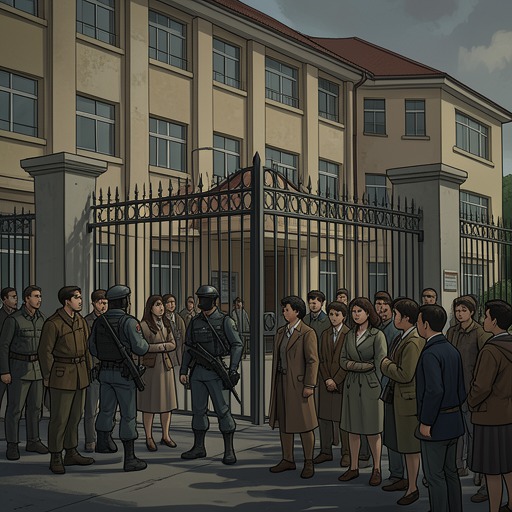
Sonny is present when Brianna’s visibility becomes dangerous rather than welcome. During the school security incident, Long restrains her while Tate takes her backpack. Sonny shouts in protest as Malik records what is happening. The episode places the friends’ loyalty in direct contrast with the security officers’ suspicion: Sonny sees Brianna as his friend being mistreated, not as the threatening figure their accusations imply. The video of the incident later circulates with a misleading caption that calls her a drug dealer, showing how a partial recording can shape the public story while omitting what led to it.
Labels, Identity, and the Novel’s Larger Conflicts
Brianna’s experience of being publicly misrepresented reverberates through Sonny’s friendship with her. Long calls her a hoodlum during the security incident, and Brianna later turns the label over in her mind, listing its supposed synonyms before rejecting the word. A school video then frames her as a drug dealer, again presenting an accusation as identity. These labels do not define Sonny, but his presence at the incident and his connection to Brianna place him among the witnesses to the gap between who she is and how institutions and audiences portray her.
That gap grows when Brianna’s song reaches a wider audience. Blackout promotes her as the daughter of Lawless, an underground rap legend, while a television report identifies her track as violent and says it is popular with young listeners. The report presents selected lyrics and shows classmates chanting one of her lines; its narration then suggests that the song encouraged students to take matters into their own hands. This mediated version of events contrasts with the smaller, firsthand moments Sonny shares with Brianna: listening to her song before its public meaning is imposed on it, and objecting when school security treats her as a suspect.
The controversy also exposes the gendered standards applied to Brianna’s music. In a radio interview, Hype challenges the violent language in her lyrics, including a line about being lawless if a police officer approaches her. Brianna points out the difference between the reaction to her and the reaction to her father, who rapped about similar material as a teenager. Elsewhere, a music-industry figure praises her using a racialized stereotype of the “sassy black girl,” language that Brianna immediately resists. Sonny is not the speaker in these scenes, but his enduring friendship belongs to the same narrative pressure: Brianna is repeatedly interpreted through labels, while those closest to her encounter a more complex person.
Characterization and Narrative Role
Sonny is characterized through recurring gestures of trust and recognition rather than through a separate public storyline. His coming-out conversation marks Brianna as someone he trusted at eleven; his later caution around a potential romantic disclosure shows that trust does not make disclosure effortless. His enthusiastic response to Brianna’s music, his easy teasing with her, and his protest when she is restrained all demonstrate forms of closeness that move between private conversation and public crisis.
His friendship also clarifies what Brianna’s growing visibility costs. The novel contrasts the wordless understanding of the “Unholy Trinity” with institutions and media that reduce her to a hoodlum, a drug dealer, a violent lyric, or a marketable stereotype. Sonny’s attention does not erase the harm of those portrayals, but it gives the story a counterpoint: before the headlines and clipped footage, Brianna is a friend whose song can be heard with delight, and whose mistreatment merits immediate protest.